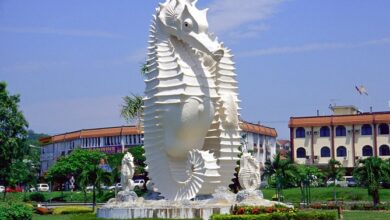
Kuching Capital City
City Overview
Kuching is the capital and largest city of Sarawak, Malaysia’s most culturally complex state. Sitting on the banks of the Sarawak River 30 kilometres inland from the South China Sea, it is Malaysia’s most relaxed and walkable city — a colonial river town that never lost its soul.
The city is defined by its relaxed pluralism. Chinese shophouses, Malay mosques, Indian temples, and Iban markets coexist without the tension sometimes felt in Peninsular cities. The waterfront promenade, colonial-era buildings, and open-air hawker centres give Kuching a pace that feels closer to a Southeast Asian river town of the 1950s than a modern state capital.
Why Kuching matters:
It is the only Malaysian city with UNESCO gastronomy recognition, the primary gateway to Borneo’s most accessible wildlife and indigenous culture, and the administrative and commercial hub for a state larger than England.
History & Colonial Heritage
Colonial Architecture Heritage
Kuching possesses the best-preserved colonial riverfront in Borneo. Key heritage buildings include:
- The Astana (1869) — Former Brooke residence; still the Governor’s official residence. Viewable from the waterfront; interior not open to public.
- Fort Margherita (1879) — White fortress across the river; now Brooke Gallery museum. Access by sampan (0.50 MYR).
- Old Court House (1871) — Former judicial centre; now cultural venue with cafes and event spaces.
- Square Tower (1879) — Originally a prison, now an event space and information centre.
- Main Bazaar Shophouses (1884–1920s) — Two-storey Chinese shophouses with five-foot walkways. Antiques, crafts, and coffee shops unchanged for generations.
- St. Thomas’s Cathedral (1955) — Anglican cathedral with distinctive Borneo timber architecture.
- Tua Pek Kong Temple (1843) — Kuching’s oldest Chinese temple, still active.
Geography & Climate
Kuching sits on the alluvial plain of the Sarawak River delta, approximately 30 kilometres from the South China Sea. The city is low-lying (elevation 8 metres) and surrounded by mangrove forests, peat swamps, and low hills.
City Layout
- South Bank (Kuching Proper): The historic core — waterfront, Main Bazaar, Chinatown, civic centre. Most attractions, hotels, and restaurants are here.
- North Bank: The Astana, Fort Margherita, Malay kampongs, and modern government buildings. Quieter, more residential.
- Padungan: Commercial district east of the centre — shopping malls, Top Spot food court, nightlife.
- Satok: Western suburb — Sunday market, government offices, residential.
- Damai / Santubong: Coastal area 35 km north — beaches, resorts, Sarawak Cultural Village, Mount Santubong.
Climate
| Season | Months | Temperature | Rainfall | Conditions |
|---|---|---|---|---|
| Wet (Monsoon) | November – February | 23–30°C | Heavy | Daily afternoon downpours; lush; some flooding possible |
| Shoulder | March – April; October | 24–31°C | Moderate | Mixed; occasional heavy rain; fewer tourists |
| Dry | May – September | 24–33°C | Light | Hot, humid; best for outdoor activities |
| Haze (variable) | August – October | 24–32°C | Dry | Transboundary smoke from Indonesian fires; check air quality |
Best time to visit Kuching:
May–September for reliable weather and outdoor dining. November–February for lush landscapes and 30–40% hotel discounts. Food travel is excellent year-round — hawker centres operate rain or shine, and wet season brings more foraged greens.
Culture & Society
Kuching is Malaysia’s most ethnically diverse city. Unlike Peninsular Malaysia’s Malay-Chinese-Indian triad, Sarawak has 40+ indigenous ethnic groups, each with distinct languages, customs, and territories. In Kuching, this diversity is compressed into a walkable urban space.
Ethnic Composition
| Community | Estimated % | Presence in Kuching |
|---|---|---|
| Chinese (Hokkien, Teochew, Hakka, Foochow) | 35–40% | Dominate commerce, Main Bazaar, hawker trade |
| Malay (including Melanau) | 25–30% | Government, waterfront kampongs, mosques |
| Iban | 15–20% | Markets, civil service, longhouse tourism links |
| Bidayuh | 8–10% | Suburban communities, cultural village |
| Indian & Others | 5–8% | Temples, textiles, small businesses |
| Orang Ulu, Penan, Kelabit | 3–5% | Artisan crafts, cultural performances, student population |
Religious Landscape
Kuching’s religious geography is a physical manifestation of its pluralism:
- Tua Pek Kong Temple (1843) — Taoist/Buddhist Chinese temple, oldest in the city
- Kuching Mosque (Masjid Bandaraya) (1968) — Modernist Islamic architecture on waterfront
- St. Thomas’s Cathedral (1955) — Anglican with Borneo timber design
- St. Joseph’s Cathedral (1969) — Catholic cathedral, largest in Borneo
- Sikh Temple (Gurdwara) — Active Sikh community, langar (free meals) on Sundays
- Hindu Temples — Several small temples serving Indian community
All these sites are within 2 kilometres of each other, and religious festivals — Chinese New Year, Gawai Dayak, Hari Raya, Christmas, Deepavali — are celebrated as public holidays with cross-community participation.
Language
| Language | Usage | Notes |
|---|---|---|
| Malay (Bahasa Malaysia) | Official, government, education | Spoken by all ethnic groups |
| English | Business, tourism, signage | Widely spoken in hotels, restaurants, shops |
| Hokkien | Chinese community, hawker centres | Dominant Chinese dialect in Kuching |
| Teochew | Older Chinese community | Declining among younger generations |
| Mandarin | Education, newer immigrants | Increasingly common |
| Iban | Iban community, markets | Largest indigenous language |
| Bidayuh | Bidayuh community | Distinct from Iban |
Festivals & Events
| Festival | Timing | Description | Where to Experience |
|---|---|---|---|
| Chinese New Year | January/February | Lion dances, firecrackers, open houses | Main Bazaar, Carpenter Street, temples |
| Gawai Dayak | 1–2 June | Iban harvest festival; ngajat dancing, tuak drinking | Sarawak Cultural Village, longhouse tours |
| Hari Raya Aidilfitri | Variable (Islamic calendar) | Malay open houses, ketupat, lemang | Malay kampongs, Kuching Mosque |
| Rainforest World Music Festival | July | 3-day international music festival at Sarawak Cultural Village | Sarawak Cultural Village (35 km) |
| Kuching Festival / Food Fair | July–August | City-wide food festival, trade fair, concerts | Kuching Waterfront, city-wide |
| Sarawak Regatta | August–September | Traditional longboat races on Sarawak River | Kuching Waterfront |
| Deepavali | October/November | Hindu festival of lights | Indian temples, homes |
| Christmas | December | Midnight mass, carolling, decorations | St. Thomas’s, hotels, waterfront |
Gastronomy — UNESCO City of Gastronomy
Kuching was designated a UNESCO City of Gastronomy in 2021 — the only city in Malaysia with this distinction. The recognition reflects not a single cuisine but a 150-year culinary archive where indigenous foraging, Chinese noodle mastery, Malay spice traditions, and Dutch colonial baking merged into something unique.
The UNESCO citation:
“Kuching’s gastronomy represents a living cultural archive where the culinary traditions of 40+ indigenous ethnic groups, Chinese migrants, Malay communities, and colonial powers have intermingled over a century and a half, creating flavours found nowhere else on Earth.”
Signature Dishes
Sarawak Laksa
Breakfast staple
Complex broth of sambal belacan, coconut milk, tamarind, and prawn stock. Topped with shredded chicken, prawns, bean sprouts, and lime. The defining dish of the city.
6–12 MYR | Chong Choon, Song Kheng Hai
Kolo Mee
Breakfast / Anytime
Springy egg noodles tossed in pork lard, topped with minced pork, char siu, and fried shallots. Kuching’s other breakfast religion.
5–8 MYR | Song Kheng Hai, Choon Hui Cafe
Manok Pansoh
Indigenous
Iban chicken cooked in bamboo with ginger, lemongrass, and tapioca leaves. The bamboo imparts sweetness while retaining moisture.
15–25 MYR | Sarawak Cultural Village, longhouse tours
Midin Belacan
Vegetable
Wild jungle fern (Stenochlaena palustris) stir-fried with toasted belacan (shrimp paste). Crisp, nutty, uniquely Sarawakian.
8–15 MYR | Every hawker centre
Kek Lapis
Dessert / Gift
Layered spice cake with Dutch colonial origins. Thin layers of spiced batter create a striped terrine. Flavours: pandan, chocolate, durian, cheese.
15–40 MYR | Main Bazaar, Sunday markets
Umai
Melanau
Raw fish salad (like ceviche) — fresh fish cured in lime juice, chilli, and shallots. Traditional Melanau fishing community dish.
12–20 MYR | Seafood restaurants, cultural events
Hawker Centre Directory
| Centre | Location | Best Time | Must-Try | Price |
|---|---|---|---|---|
| Chong Choon | Jalan Abell | 7 AM – 2 PM | Sarawak Laksa (Stall 14) | 6–12 MYR |
| Top Spot | Jalan Padungan | 5 PM – 11 PM | Butter prawns, chili crab | 25–80 MYR |
| Song Kheng Hai | Jalan Song Kheng Hai | 6 PM – 12 AM | Kolo Mee (Stall 3), ABC | 5–15 MYR |
| Lau Ya Keng | Carpenter Street | 7 AM – 3 PM | Hokkien Mee, Kaya Toast | 4–12 MYR |
| Satok Sunday Market | Jalan Satok | Sun 5 AM – 12 PM | Fresh produce, jungle ingredients | Variable |
| Bako Village | Bako (pre-park) | 11 AM – 3 PM | Fresh river fish, midin | 10–25 MYR |
Cooking Classes & Food Tours
| Operator | Experience | Duration | Cost (2026) |
|---|---|---|---|
| Kuching Food Tours | Guided hawker centre crawl | 3–4 hours | From 150 MYR/person |
| Paradesa Borneo | Cycling + food tour | 4–6 hours | From 120 MYR/person |
| Sarawak Cultural Village | Structured cooking class | Half-day | From 150 MYR/person |
| Nanga Sumpa Longhouse | Authentic open-fire cooking | Full-day | From 200 MYR (with meal) |
Key Attractions
Sarawak Cultural Village
A living museum featuring authentic longhouses of 7 major ethnic groups: Iban, Bidayuh, Penan, Orang Ulu, Melanau, Malay, and Chinese. Staffed by community members, not actors. Cultural performances at 11:30 AM and 2:30 PM. The Rainforest World Music Festival is held here annually in July. Allow 3–4 hours. Combine with Damai Beach for a full day.
Semenggoh Nature Reserve
A 653-hectare forest reserve and orangutan rehabilitation centre. Unlike more commercialised facilities elsewhere, Semenggoh focuses on semi-wild release — orangutans roam freely, returning only when forest fruit is scarce. The most ethical orangutan encounter in Borneo. Feeding times: 9:00–10:00 AM and 3:00–3:30 PM. No guaranteed sightings — this is a good thing. Arrive 30 minutes early. Bring rain gear and leech socks.
Kuching Waterfront & Main Bazaar
The historic heart of Kuching — a 1-kilometre riverfront promenade lined with 19th-century Chinese shophouses, the Astana, Fort Margherita, and the Square Tower. The best-preserved colonial riverfront in Borneo. Main Bazaar and Carpenter Street contain antique dealers, tribal craft shops, and family-run coffee shops unchanged for generations. Best at early morning (7:00–9:00 AM) for market activity or sunset for river views. Cross the river via sampan (0.50 MYR) to Fort Margherita.
Cat Museum
Kuching means “cat” in Malay, and the city embraces the identity. This municipal museum on Bukit Siol houses 4,000+ cat artefacts — from ancient Egyptian cat mummies to Hello Kitty. Surprisingly comprehensive and oddly compelling. Good for families and rainy days. Open 9:00 AM – 4:30 PM (closed Mondays).
Bako National Park (Day Trip)
Sarawak’s oldest national park (1957), located on a peninsula. Contains 7 distinct ecosystems from mangrove to kerangas (heath forest) to cliff vegetation. Best proboscis monkey viewing in Borneo. Iconic Telok Pandan Kecil sea stack beach. Bearded pigs roam the campgrounds. Night walks for frogs and nocturnal mammals. Bus from Kuching to Bako Village (45 min), then boat to park HQ (20 min, tide-dependent). Stay overnight for the full experience (hostel beds available).
Satok Sunday Market
The largest wet market in Kuching and one of the biggest in Malaysia. Opens at 5:00 AM. A sensory overload of tropical fruits, jungle vegetables, live seafood, exotic meats, and traditional medicines. The best place to see midin, wild ginger, and other ingredients that define Sarawakian cuisine. Arrive early for the best selection. Bring cash and a strong stomach.
Experiences & Activities
Within the City
| Experience | Description | Duration | Cost (2026) |
|---|---|---|---|
| Heritage Walking Tour | Self-guided or guided walk through Main Bazaar, Carpenter Street, waterfront, temples | 2–3 hours | Free (self) / 80 MYR (guided) |
| River Cruise | Evening cruise on Sarawak River with city lights view | 1 hour | 30–50 MYR |
| Sampan Crossing | Traditional boat across the river to Fort Margherita | 5 minutes | 0.50 MYR |
| Kopitiam Hopping | Visit traditional coffee shops for kaya toast, soft-boiled eggs, and local coffee | 1–2 hours | 10–20 MYR |
| Antique Hunting | Browse Main Bazaar for tribal crafts, beads, brassware, and colonial memorabilia | 2–4 hours | Variable |
Day Trips from Kuching
| Destination | Distance | Highlight | Duration | Cost |
|---|---|---|---|---|
| Semenggoh Nature Reserve | 24 km | Wild orangutan rehabilitation | Half-day | 20 MYR + transport |
| Sarawak Cultural Village | 35 km | 7 ethnic longhouses, cultural shows | Half-day | 60 MYR + transport |
| Bako National Park | 30 km + boat | Proboscis monkeys, sea stack beach | Full day / overnight | 30 MYR + transport |
| Damai Beach / Santubong | 35 km | Beach, resorts, Mount Santubong trek | Full day | Free (beach) / resort costs |
| Fairy Cave & Wind Cave | 50 km | Limestone caves, Buddhist shrine | Half-day | Free + transport |
| Jong’s Crocodile Farm | 30 km | Crocodile feeding, breeding centre | Half-day | 20 MYR |
Multi-Day Excursions
| Destination | Duration | Experience | Cost (2026) |
|---|---|---|---|
| Batang Ai Longhouses | 2–3 days | Iban homestay, jungle trekking, tuak brewing | From 600 MYR/person |
| Gunung Mulu National Park | 3–5 days | Flight via Miri; caving, bat exodus, rainforest | From 1,500 MYR/person |
| Batang Rejang River | 3–5 days | Express boat to interior longhouses | From 1,200 MYR/person |
Where to Stay
By Neighbourhood
| Area | Vibe | Best For | Notable Properties |
|---|---|---|---|
| Kuching Waterfront | Colonial, walkable, gastronomic | First-timers, food travellers, culture seekers | Grand Margherita, Riverside Majestic, Hilton |
| Padungan | Commercial, dining, nightlife | Budget travellers, night owls | Lodge 121, Singgahsana Lodge |
| Damai / Santubong | Beach, jungle, resort | Families, couples, beach+nature combo | Damai Beach Resort, Permai Rainforest Resort |
| Satok | Residential, market access | Budget travellers, long-stay | Mid-range hotels, guesthouses |
By Category
| Category | Price Range (2026) | Properties | Best For |
|---|---|---|---|
| Luxury (4–5 star) | 400–800+ MYR | Hilton Kuching, Pullman Kuching | Business, bleisure, MICE delegates |
| Mid-Range (3 star) | 150–400 MYR | Grand Margherita, Riverside Majestic, Abell Hotel | Leisure travellers, families |
| Boutique | 120–250 MYR | The Marian, LimeTree Hotel, Riverside Lodge | Couples, design-conscious travellers |
| Budget / Hostel | 40–120 MYR | Singgahsana Lodge, Lodge 121, Borneo Seahare | Solo travellers, backpackers |
| Heritage | 200–400 MYR | Ranee Boutique Suites (Main Bazaar), The Marian | Culture seekers, photographers |
Booking tip:
Waterfront hotels command a premium for river views. For better value, stay in Padungan (10-minute walk to waterfront) or book heritage properties in Main Bazaar for authentic atmosphere. Book 3–6 months ahead for Rainforest World Music Festival (July) and Chinese New Year.
Getting Around
From Kuching International Airport (KCH)
| Mode | Time | Cost (2026) | Notes |
|---|---|---|---|
| Grab | 20–30 min | 15–25 MYR | Most reliable; book via app |
| Airport Taxi | 20–30 min | 30–40 MYR (fixed) | Prepaid counter at arrivals |
| Hotel Transfer | 20–30 min | 25–50 MYR | Book through hotel |
| Bus | 45–60 min | 5 MYR | Infrequent; not recommended with luggage |
Within Kuching
| Mode | Best For | Cost (2026) | Notes |
|---|---|---|---|
| Walking | Waterfront, Main Bazaar, Carpenter Street | Free | City centre is compact and flat |
| Grab | All destinations | From 6 MYR | Dominates ride-hailing; cash or card |
| Taxi | Airport, late night | Negotiate or meter | Less common than Grab |
| Sampan | River crossing | 0.50 MYR | Traditional wooden boat; nostalgic |
| Bus | Budget travel, Bako access | 2–5 MYR | Basic; limited English signage |
| Bicycle | Waterfront, parks | 20–40 MYR/day rental | Flat terrain; limited dedicated lanes |
| Rental Car | Day trips, multi-day | From 120 MYR/day | Drive on left; parking can be challenging |
Inter-City Connections
| Destination | Mode | Duration | Cost (2026) |
|---|---|---|---|
| Miri | Flight | 1 hour | 120–250 MYR |
| Sibu | Flight | 45 min | 80–150 MYR |
| Sibu | Express boat | 5+ hours | 35–50 MYR |
| Bintulu | Flight | 45 min | 100–180 MYR |
| Batang Ai | 4WD + longboat | 4–5 hours | 250–400 MYR (charter) |
| Mulu | Flight via Miri | 2.5 hours | 250–400 MYR |
Practical Information
Essential Services
| Service | Location / Contact | Notes |
|---|---|---|
| Tourist Police | +60 82 244 444 | English-speaking; near waterfront |
| Sarawak General Hospital | Jalan Hospital | Public; emergency services |
| Normah Medical Specialist Centre | Petra Jaya | Private; excellent facilities |
| Timberland Medical Centre | Jalan Rock | Private; international standard |
| Main Post Office | Jalan Tun Haji Openg | Colonial building; philatelic museum upstairs |
| Tourist Information Centre | Kuching Waterfront | Maps, brochures, event listings |
Money & Connectivity
- Currency: Malaysian Ringgit (MYR). ATMs plentiful in city centre; limited in suburbs.
- Cash: Essential for hawker centres, markets, and small shops. Many stalls do not accept cards.
- Cards: Visa/Mastercard accepted in hotels, malls, and upscale restaurants. Amex limited.
- Digital: Touch ‘n Go, GrabPay, Boost widely used. QR code payments common in Chinese-owned businesses.
- Wi-Fi: Available in all hotels, most cafes, and malls. Speeds adequate for streaming.
- Mobile: 4G coverage city-wide. Celcom and Maxis have best rural coverage if extending beyond Kuching.
- Prepaid SIM: Available at KCH airport from 25 MYR. Passport required for registration.
Safety & Etiquette
General safety:
Kuching is very safe for travellers. Violent crime is rare. Standard precautions apply: watch bags in markets, avoid unlit areas late at night, use licensed taxis/Grab.
- Emergency: Police/Ambulance 999; Fire 994
- Tap water: Not recommended. Drink bottled or boiled water.
- Heat: Dehydration risk year-round. Carry water and acclimatise gradually.
- Mosquitoes: Dengue present. Use repellent and cover up at dawn/dusk.
- LGBTQ+ travellers: Homosexuality is illegal in Malaysia. Public discretion essential.
- Dress: Casual acceptable everywhere. Modest dress for temples and rural visits.
- Tipping: Not customary. 10% service charge often added to restaurant bills.
B2B & MICE Infrastructure
Convention Facilities
| Venue | Capacity | Features | Distance from Airport |
|---|---|---|---|
| Borneo Convention Centre Kuching (BICC) | 5,000+ delegates | Purpose-built; 15 function rooms; 2,000 sq m exhibition | 15 min |
| Pullman Kuching Ballroom | 800 | Adjacent to BICC; 1,200 sq m meeting space | 15 min |
| Hilton Kuching | 600 | Waterfront; colonial heritage ambiance | 20 min |
| Riverside Majestic | 400 | Connected to shopping mall; value option | 20 min |
| Old Court House | 100–200 | Heritage venue for gala dinners and receptions | City centre |
Unique Offsite Venues
- Sarawak Cultural Village: Cultural performances + dinner for 200–500 guests. 35 km from city.
- Damai Beach Resort: Beachfront team-building, jungle trekking, wellness programs. 35 km.
- Bako National Park: Adventure team-building, wildlife spotting, conservation CSR. 30 km + boat.
- Kuching Waterfront: Riverfront networking receptions, heritage gala dinners. City centre.
Local DMCs & Partners
| Company | Specialty | Contact |
|---|---|---|
| Greatown Travel | MICE, corporate, BICC logistics | greatown.com |
| Paradesa Borneo | Cultural experiences, food tours, cycling | paradesaborneo.com |
| Borneo Adventure | Responsible tourism, longhouse, Mulu | borneoadventure.com |
| Sarawak Tourism Federation | Industry association, networking | stf.org.my |
Kuching MICE advantage:
Costs are 40–50% below Kuala Lumpur and 60% below Singapore for equivalent facilities. The city’s compact size means all venues, hotels, and offsite locations are within 45 minutes of each other. Bleisure extensions — orangutans, longhouses, rainforest — are unique selling points that increase delegate satisfaction and per-delegate spend.